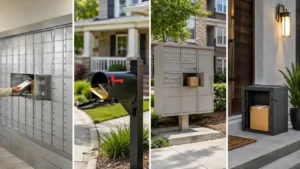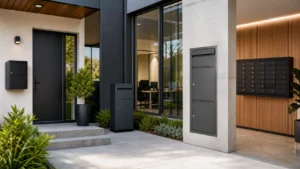
Installation Type
There is no single standard mailbox size that works for every home or property.
A compact wall-mounted mailbox may be large enough for letters and bills. A large curbside mailbox may hold magazines, padded envelopes, and a few small packages. A property that receives regular online orders may need a parcel box instead of a larger traditional mailbox.
The key is to look beyond the outside dimensions.
A mailbox can appear large but still have a narrow delivery slot, a small retrieval door, or an internal security plate that reduces usable space. For this reason, the right size should be selected by checking:
- What will be delivered
- How often deliveries arrive
- How long items stay inside
- The clear delivery opening
- The usable internal compartment
- The retrieval-door size
- The available installation space
This guide explains common mailbox sizes, how to measure a mailbox correctly, when to choose a parcel box, and what commercial buyers should confirm before ordering custom mailbox products.
What Is a Standard Mailbox Size?
“Standard mailbox size” can mean several different things.
It may refer to:
- A common residential mailbox sold by retailers
- A mailbox that fits a commonly used post or mounting bracket
- A mailbox designed for normal daily mail
- A curbside mailbox approved under USPS requirements
- A supplier’s medium-size product category
These meanings are not interchangeable.
There is no universal outside measurement that applies to every wall-mounted, curbside, locking, freestanding, or parcel mailbox.
A wall-mounted mailbox is usually designed around envelopes and magazines. A curbside mailbox is normally deeper so that a mail carrier can place items through the front door. A parcel box is often taller because packages need more vertical storage space.
The words small, medium, large, and extra large are useful for comparing products within one product range. However, they are not exact engineering standards.
A “large” mailbox from one supplier may have less usable capacity than a “medium” mailbox from another supplier.
For an accurate comparison, always request a dimension drawing.
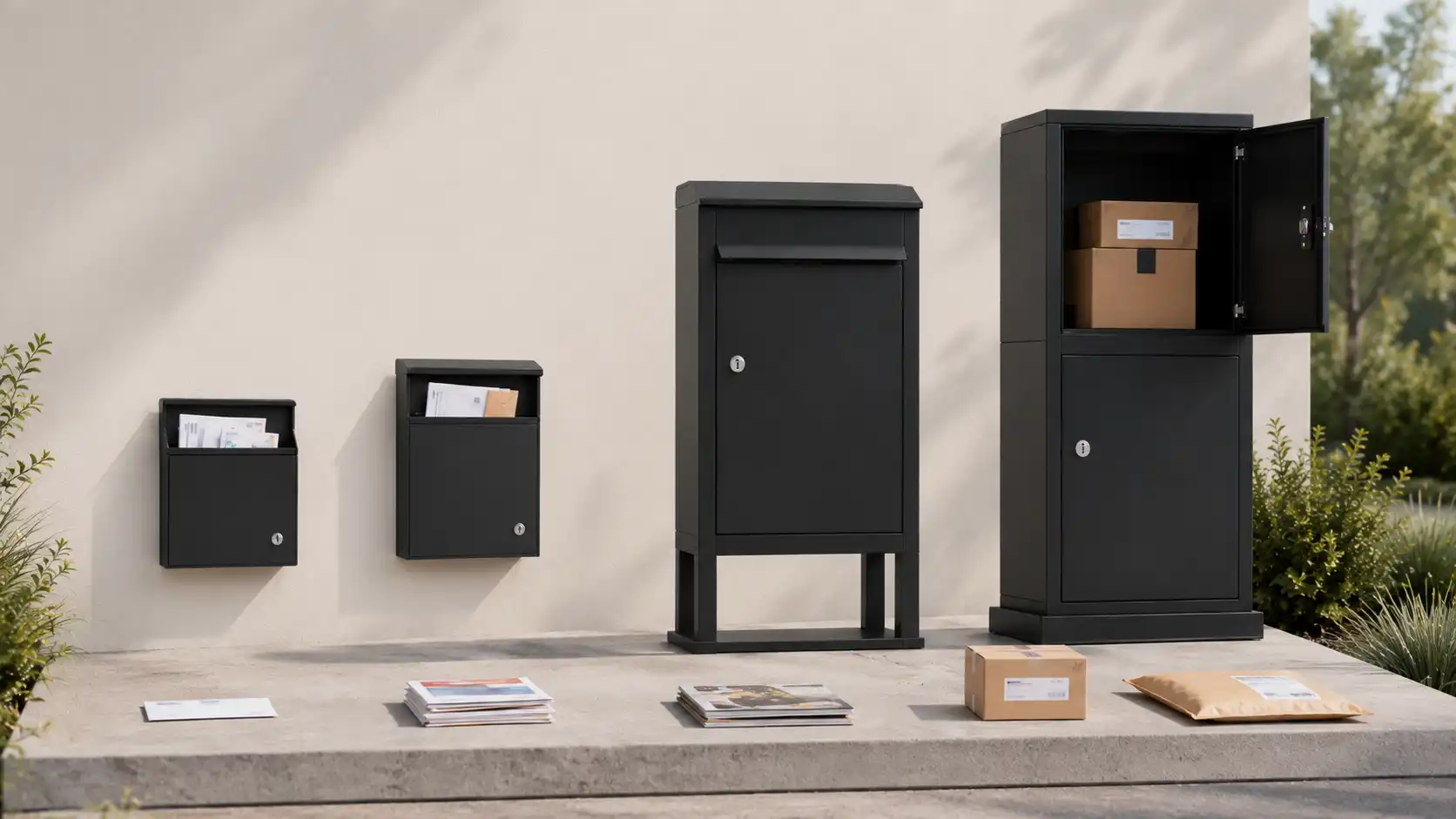
Mailbox Size Chart by Product Type
The following chart explains how different mailbox types are normally used. Actual dimensions vary by manufacturer and model.
| Mailbox Type | Designed to Receive | Most Important Dimensions | Common Applications |
|---|---|---|---|
| Wall-mounted letterbox | Letters, cards, bills, magazines | Mail-slot width, internal depth, retrieval opening | Houses, townhouses, offices |
| Door mail slot | Letters and thin documents | Clear slot width, slot height, door thickness | Houses and apartments with door delivery |
| Standard curbside mailbox | Daily letters, magazines, catalogs, small mailers | Front-door opening, internal width, internal depth | Detached houses and rural homes |
| Large-capacity curbside mailbox | High mail volume, catalogs, padded envelopes, small boxes | Clear front opening and usable internal capacity | Large families and rural properties |
| Locking mailbox | Letters, checks, documents, small mailers | Incoming slot, security plate, retrieval door | Homes, offices, rental properties |
| Freestanding parcel box | Packages, padded envelopes, online orders | Parcel opening, drop mechanism, storage chamber | Homes and small businesses |
| Through-wall mailbox | Letters or parcels passing through a wall or gate | Wall depth, front opening, rear retrieval door | Villas, gated homes, commercial properties |
| Multi-unit mailbox | Separate mail for several users | Compartment size, number of doors, overall footprint | Apartments, offices, student housing |
| Parcel locker | Packages for multiple recipients | Locker sizes, door configuration, user access | Multifamily and commercial projects |
This table highlights an important point:
The largest outside mailbox is not always the mailbox that accepts the largest delivery item.
A locking mailbox may have a large body but a narrow mail slot. A parcel box may have a wide upper opening but a smaller internal path because of its anti-fishing baffle.
The opening and internal path must be checked together.
Which Mailbox Size Do You Need?
The right size depends more on delivery habits than on the size of the house.
Before selecting a product, answer these five questions.
1. What Do You Receive Most Often?
Start with the most common delivery type.
For example:
- Letters and bills
- Magazines
- Catalogs
- Large document envelopes
- Padded mailers
- Medicine packages
- Small product boxes
- Regular online orders
A small mailbox may be enough for daily letters. It may not be suitable for unfolded magazines or document envelopes.
If padded mailers and boxes arrive regularly, increasing the size of a traditional mailbox may not solve the problem. A parcel box may provide a more suitable opening and storage chamber.
2. How Often Do You Collect the Mail?
A mailbox does not only need to hold one delivery.
It may need to store several days of mail before the owner opens it.
A smaller mailbox may work when mail is collected every day. More capacity may be necessary for:
- Vacation homes
- Rural homes
- Rental properties
- Busy households
- Part-time offices
- People who travel frequently
- Properties where mail is collected weekly
Always select capacity for a busy delivery period rather than an unusually quiet day.
The number of users has a direct effect on capacity.
One resident may only receive a few letters each week. A family of five may receive letters, magazines, bank documents, school notices, and online purchases at the same address.
A shared office mailbox may need to hold mail for several departments.
For multifamily properties, one oversized shared mailbox is usually not a suitable replacement for individual tenant compartments. Separate user access, identification, security, and management procedures must also be considered.
4. What Is the Largest Regular Delivery?
Do not choose the size based only on the largest item ever delivered.
Measure the largest item that arrives often.
For example, if a household receives a 10-inch-wide magazine every week, the opening and internal space should allow that magazine to enter without being rolled or folded.
For package delivery, record three measurements:
- Package width
- Package height
- Package depth
Then leave enough clearance for the item to pass through the opening without being forced.
5. Is Security More Important Than Capacity?
A larger mailbox is not automatically a more secure mailbox.
If the box receives checks, business documents, medicines, keys, or personal information, a locking design may be more important than a larger open compartment.
However, locks and anti-theft structures take up space.
A secure mailbox may contain:
- An anti-fishing plate
- A narrow incoming slot
- A protected lock housing
- A sloped internal baffle
- Reinforced door edges
- Hidden hinges
These parts may reduce usable capacity. This is why internal dimensions should be checked instead of relying only on the outside size.
Small, Medium, Large, and Extra-Large Mailboxes
Mailbox size labels are not exact standards, but they can still help buyers narrow down their options.
Small Mailboxes
A small mailbox is normally designed for light, frequent mail collection.
It is suitable for:
- Letters
- Postcards
- Bills
- Greeting cards
- Small envelopes
- A small number of documents
Small mailboxes are often used on exterior walls near the entrance of a house.
Their main advantages are:
- Compact installation
- Lower material cost
- Lower shipping volume
- Simple wall mounting
- Easy fit beside narrow doors or gates
A small mailbox may not be suitable when the user receives magazines, catalogs, thick envelopes, or several days of mail at one time.
The most common problem is not that the mailbox looks full. It is that later deliveries may remain exposed because the mail cannot drop completely into the box.
Medium Mailboxes
A medium mailbox is often suitable for normal residential use.
It may receive:
- Letters
- Documents
- Magazines
- Catalogs
- Several days of mail
- Small padded envelopes
Medium mailboxes offer a useful balance between capacity and installation size.
However, buyers should pay attention to shape.
A tall but shallow mailbox may have enough volume for loose letters but may not hold a magazine flat. A wide mailbox with a narrow slot may still bend large envelopes during delivery.
For magazines and documents, confirm:
- Clear slot width
- Usable internal width
- Internal depth
- Retrieval-door opening
Large Mailboxes
A large mailbox is designed for greater mail volume or larger mailpieces.
It may be suitable for:
- Large families
- Home offices
- Rural properties
- Properties with weekly mail collection
- Catalog deliveries
- Large envelopes
- Padded mailers
- Some small boxes
A large curbside mailbox may accept small packages, but the opening must be checked carefully.
A product can have a deep body while still using a small front door. The maximum package size is determined by the narrowest part of the delivery path, not by the widest part of the body.
When comparing large mailbox dimensions, ask for:
- Clear door width
- Clear door height
- Internal floor width
- Internal height
- Internal depth
- Door hinge clearance
Extra-Large Mailboxes
An extra-large mailbox provides more space for high mail volume and some package deliveries.
It can be useful for:
- Frequent online shoppers
- Large households
- Small offices
- Vacation homes
- Rural properties
- Customers who do not collect mail every day
An extra-large mailbox is not automatically a parcel box.
The difference is usually found in the delivery system.
A traditional extra-large mailbox may use one front door. A parcel box may use:
- A separate package door
- A top-loading hatch
- A one-way drop system
- An anti-fishing baffle
- A locked lower storage chamber
If packages are the main reason for selecting a larger size, compare the product with a parcel box before ordering.
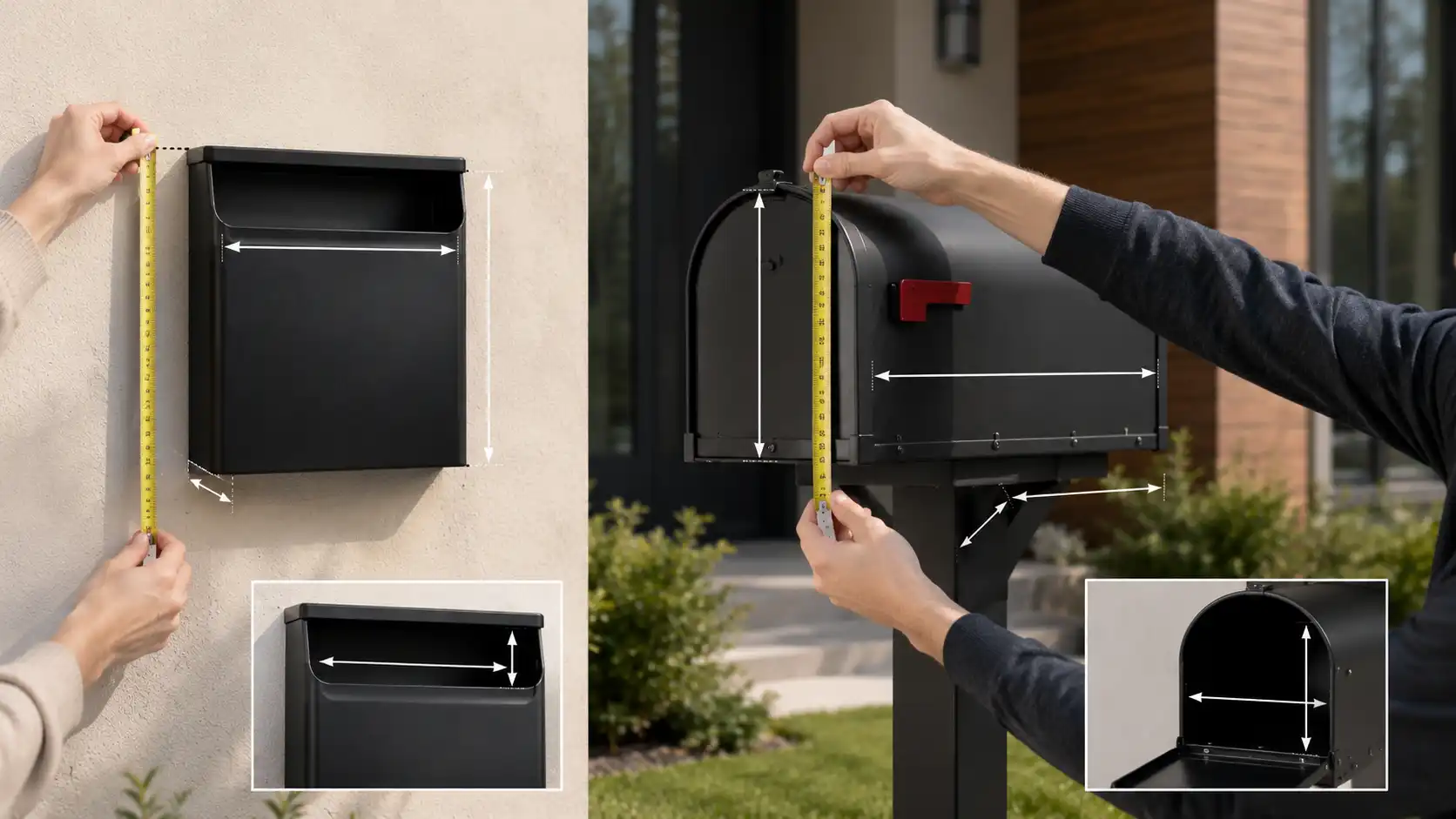
How to Measure a Mailbox Correctly
A mailbox should be measured in three areas:
- Outside dimensions
- Delivery dimensions
- Usable storage dimensions
This gives a much more accurate picture than using overall width, height, and depth alone.
Measure the Overall Width
Measure the widest fixed point from left to right.
Include fixed trims, side flanges, and permanent handles if the product must fit into a narrow installation area.
For multi-unit systems, include gaps, frames, side panels, and fixing channels in the total width.
Measure the Overall Height
Measure from the lowest fixed part to the highest fixed part of the body.
For curved-top curbside mailboxes, record both:
- Side-wall height
- Maximum center height
This can be important when the mailbox must fit into an enclosure or under a structure.
Measure the Overall Depth
Measure from the front of the closed mailbox to the rear panel.
For wall-mounted and freestanding products, remember that the door may require extra space to open.
The installed space should therefore include both:
- Product depth
- Door-opening clearance
Measure the Clear Delivery Opening
Measure the space that the letter, magazine, or package can actually pass through.
Do not measure the decorative frame around the opening.
For a hinged slot, open the flap and measure the smallest clear width and height.
For a parcel box, check the opening at every stage of the delivery movement. The first opening may be large, while the lower internal path is smaller.
Measure the Usable Internal Compartment
Internal capacity is reduced by components such as:
- Locks
- Hinges
- Door frames
- Anti-fishing plates
- Parcel baffles
- Internal shelves
- Drainage channels
- Reinforcement ribs
- Sloped floors
Measure the clear space available after these parts are installed.
For parcel products, ask for the largest rectangular package that can be placed inside, not only the total volume in liters or cubic feet.
Measure the Retrieval Door
The customer must be able to remove the stored item.
A package may enter through a large top opening and then become difficult to remove through a smaller lower door.
Check:
- Clear retrieval width
- Clear retrieval height
- Door-opening angle
- Lock position
- Internal threshold height
This is especially important for rear-access, through-wall, locking, and parcel-delivery products.
Measure the Mounting Area
For replacements and renovation projects, record:
- Mounting-hole spacing
- Base width
- Base depth
- Wall-fixing positions
- Post size
- Bracket size
- Required fixing hardware
Do not assume that every mailbox described as “standard size” fits the same post or bracket.
Why Outside Dimensions Can Be Misleading
Two mailboxes can have the same outside dimensions but provide very different usable capacity.
Consider two boxes that are both 20 inches deep.
The first has:
- A simple front door
- Thin walls
- An open interior
- No security baffle
The second has:
- A mail slot
- An internal anti-fishing plate
- A lock housing
- Reinforced door edges
- A sloped security panel
Although both products have the same outside depth, the second product may hold fewer or smaller items.
Use the following four measurements when comparing mailbox sizes:
| Measurement | Why It Matters |
| Overall dimensions | Confirms whether the product fits the installation area |
| Clear delivery opening | Confirms whether the item can enter |
| Usable internal space | Shows how much mail or how many packages can be stored |
| Retrieval opening | Confirms whether stored items can be removed |
For parcel boxes, there is one more measurement:
The largest package that can pass through the complete delivery path.
This is often more useful than total storage volume.
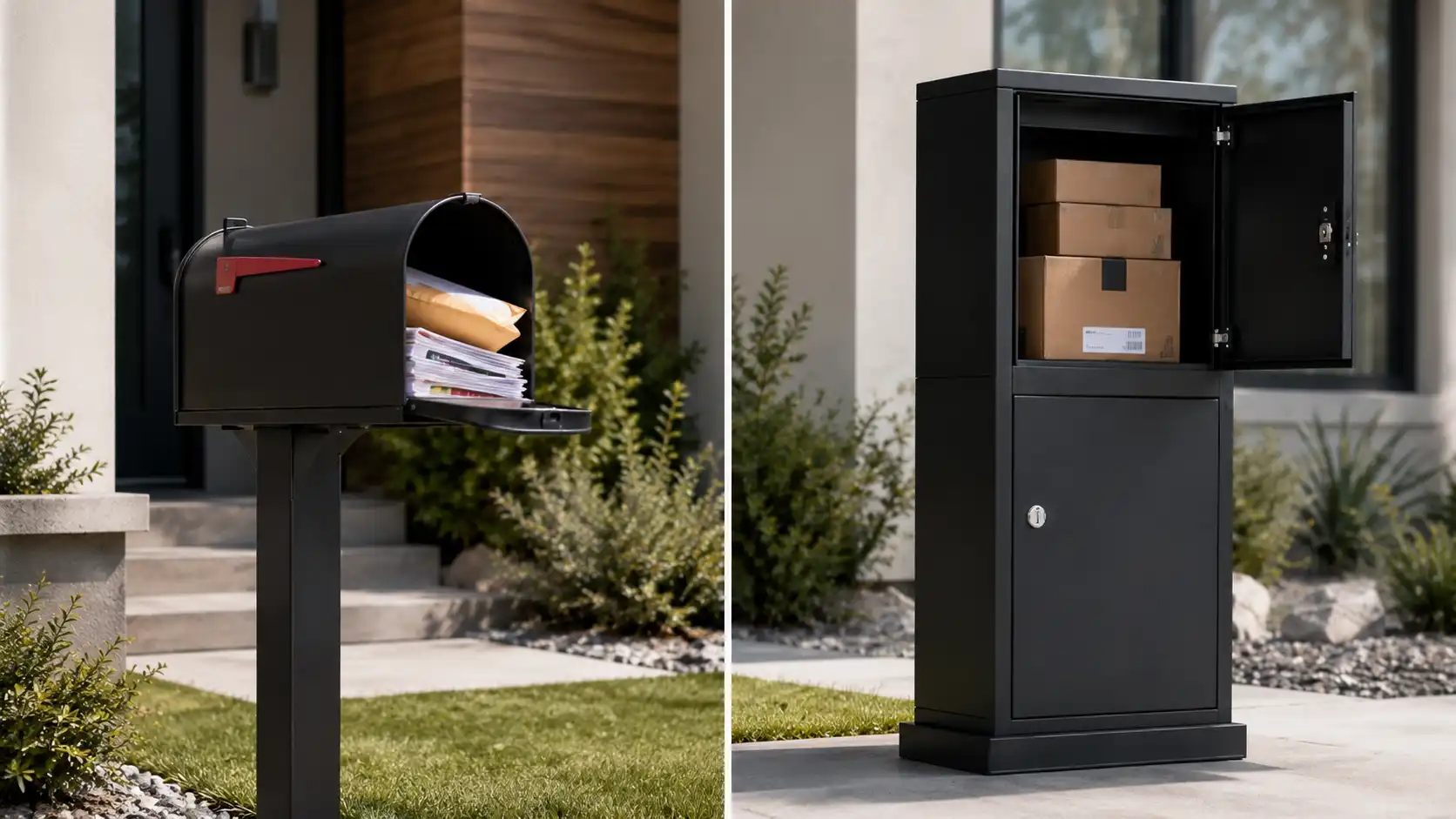
Mailbox Size vs. Parcel Box Size
A mailbox and a parcel box should not be selected in the same way.
A mailbox is mainly designed around letters, documents, and daily mail.
A parcel box is designed around package dimensions, secure drop movement, and storage capacity.
| Delivery Requirement | Standard Mailbox | Large Mailbox | Parcel Box |
| Letters and bills | Suitable | Suitable | Usually suitable |
| Magazines | Depends on opening | Suitable in many models | Usually suitable |
| Large envelopes | Limited in small models | Suitable in many models | Usually suitable |
| Padded mailers | Small sizes only | Some sizes | Suitable |
| Small boxes | Usually limited | Some models | Suitable |
| Medium packages | Usually unsuitable | Often unsuitable | Suitable in correctly sized models |
| Multiple packages | No | Limited | Depends on storage chamber |
| Locking storage | Optional | Optional | Common |
| Anti-fishing system | Available in some models | Available in some models | Common |
| Separate package opening | Rare | Rare | Standard feature in many models |
Choose a standard mailbox when most deliveries are letters.
Choose a large mailbox when the main problem is higher mail volume.
Choose a parcel box when the main problem is package size, package security, or missed delivery.
In some properties, the best solution is to use both:
- A letter opening for normal mail
- A separate secure parcel compartment for packages
Choosing Mailbox Size by Project Type
Mailbox dimensions should be selected according to the users, delivery volume, available installation space, and the way mail or parcels are managed.
The requirements of an office are different from those of a university, apartment project, retail location, or hotel. Architects may also need custom dimensions that fit the building design rather than an off-the-shelf mailbox size.
Office Mailbox Solutions
Office mailboxes may receive more than letters.
Common deliveries include:
- Contracts and business documents
- Catalogs
- Product samples
- Padded envelopes
- Replacement parts
- Small packages
A small office may only need one secure locking mailbox. A larger building may require separate compartments for different companies, departments, or floors.
When selecting mailbox dimensions for an office, consider:
- Number of businesses or departments
- Daily document volume
- Largest regular envelope
- Package frequency
- Front or rear retrieval
- Staff-only access
- Company nameplates
- Available wall or floor space
For offices that receive regular product samples or online orders, a combined mailbox and parcel box system may be more practical than a large letterbox alone.
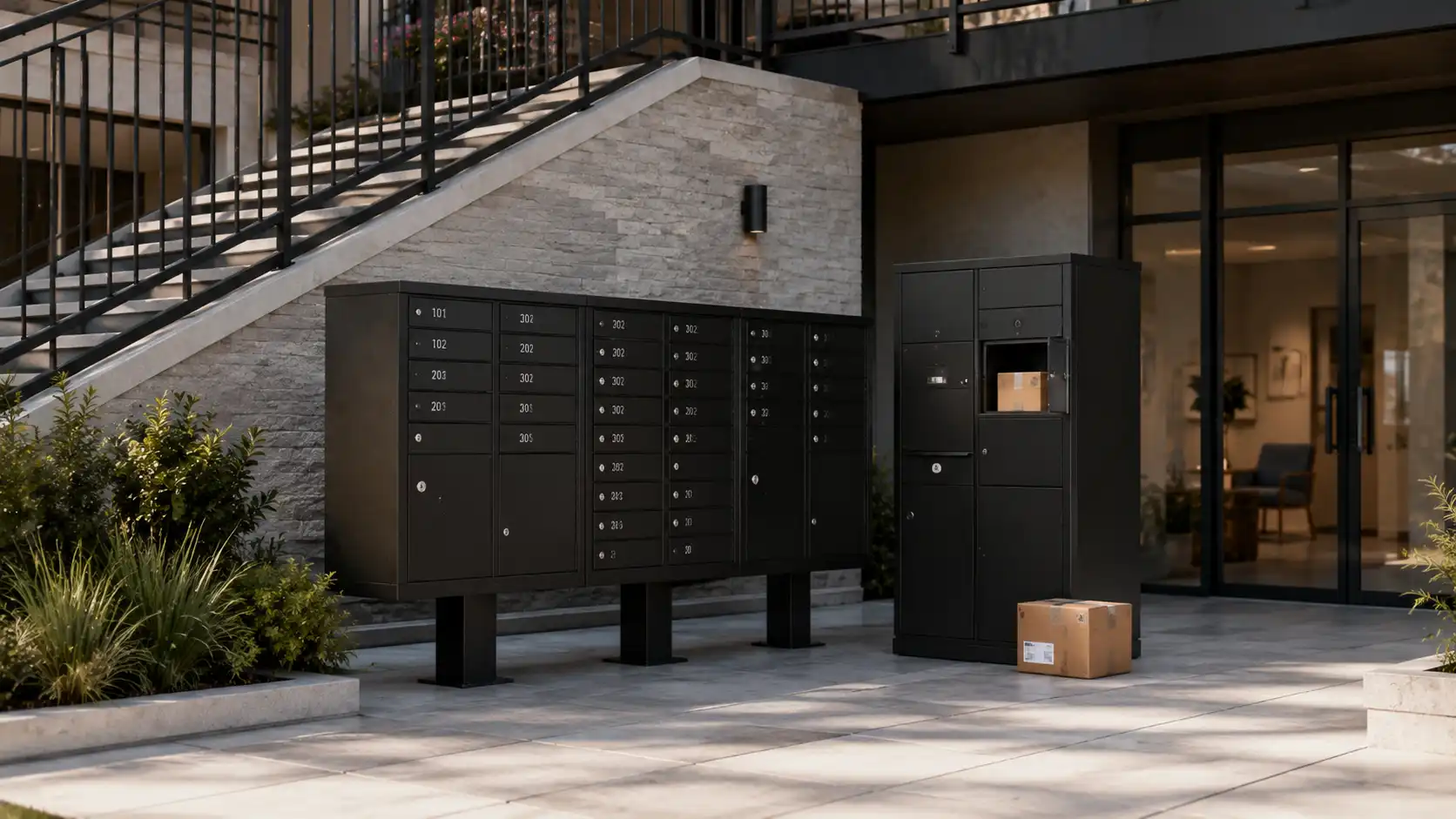
Multifamily Mailbox Solutions
Multifamily properties normally require individual mail compartments rather than one large shared mailbox.
The system may include:
- Individual tenant mailboxes
- Shared parcel lockers
- Management compartments
- Outgoing mail slots
- Master-key access
- Unit number plates
- Replacement lock options
Mailbox size should be calculated separately from parcel storage.
A building may need compact letter compartments for each apartment but larger shared parcel lockers because package volume is much higher than letter volume.
Before selecting compartment dimensions, confirm:
- Number of residential units
- Average mail volume per resident
- Expected parcel volume
- Peak delivery periods
- Average package storage time
- Available installation area
- Front-loading or rear-loading access
- Future building expansion
Retail Mailbox Solutions
Retail properties may receive business mail, invoices, stock samples, replacement parts, and online orders.
A small wall-mounted mailbox may be enough for a local store with daily staff collection. Larger retail sites may need a locking mailbox or parcel box that can hold deliveries outside business hours.
Important sizing factors include:
- Size of invoices and documents
- Frequency of stock samples
- Small-part deliveries
- Opening and closing hours
- Staff retrieval access
- Security requirements
- Visibility from public areas
- Available back-door or entrance space
For shopping centers or mixed-use retail developments, several labeled compartments may be more useful than one oversized mailbox.
University Mailbox Solutions
Universities and student accommodation projects often experience high delivery volumes and strong seasonal peaks.
Demand may increase during:
- Student move-in periods
- The beginning of a term
- Holiday shopping periods
- Examination periods
- Campus events
A letter-only system may quickly become overloaded when students receive frequent online orders.
Project planners should evaluate:
- Number of students and staff
- Mail volume per user
- Daily parcel volume
- Peak delivery periods
- Oversized-package handling
- Average collection time
- Staff management procedures
- User identification
- Electronic or mechanical access
A combination of individual mail compartments and shared parcel lockers usually uses space more efficiently than making every mailbox extra large.
Hospitality Mailbox Solutions
Hotels, resorts, serviced apartments, and short-term accommodation properties may receive mail and packages for guests, staff, and different departments.
The mailbox system may need to handle:
- Guest letters
- Business documents
- Supplies
- Replacement items
- Online orders
- Temporary recipients
- Staff-only deliveries
Hospitality projects often require flexible compartment sizes because the type and volume of deliveries can change.
Useful design options include:
- Front delivery and rear staff retrieval
- Locking compartments
- Temporary guest labels
- Different compartment sizes
- Custom colors
- Hotel or property branding
- Weather-resistant outdoor construction
- Parcel storage near reception
The mailbox dimensions should also match the property’s interior or exterior design.
Architect Mailbox Solutions
Architects normally need more than a standard product size.
The mailbox or parcel system may need to fit into:
- A wall recess
- An entrance lobby
- A fence
- A gate
- A freestanding landscape structure
- A custom cabinet
- A centralized mailroom
For architectural projects, the available opening or wall space is often fixed before the mailbox design is finalized.
Architects should provide:
- Overall available width, height, and depth
- Wall or cabinet opening dimensions
- Required number of compartments
- Front or rear access
- Door-opening direction
- Material and finish requirements
- Color references
- Installation details
- Drawings or BIM information
- Local postal or accessibility requirements
Custom manufacturing allows the mailbox dimensions, door layout, material, color, and mounting structure to match the building instead of forcing the building to fit a standard mailbox.
USPS Mailbox Dimensions and Approval Requirements
USPS does not require every curbside mailbox to have the same outside dimensions.
Instead, USPS-STD-7C covers the design, capacity, construction, testing, and approval of curbside mailboxes.
For limited-capacity traditional and contemporary designs, USPS uses a capacity test gauge measuring:
- 18.5 inches long
- 5 inches wide
- 6 inches high
The gauge must be inserted and removed easily while allowing the mailbox door to close.
USPS also uses a larger test gauge for expanded-capacity designs. These are testing dimensions, not universal outside mailbox dimensions.
This distinction is important.
A manufacturer can use different outside shapes, materials, roofs, wall thicknesses, and door structures. However, a mailbox marketed as USPS approved must meet the applicable USPS approval and testing requirements.
According to USPS guidance published in 2026, approved manufactured curbside mailboxes are required to display “Approved by the Postmaster General” and “U.S. Mail” on the front. Custom-built curbside boxes may be accepted for an individual customer when the local postmaster approves them and they generally meet the relevant requirements.
For curbside installation, USPS currently advises:
- Positioning the bottom of the mailbox or point of mail entry 41–45 inches above the road surface
- Placing the mailbox door 6–8 inches back from the curb or road edge
- Contacting the local Post Office before installation because road and route conditions can vary.
Installation height answers a different search question from mailbox body size, so it should be explained in a separate mailbox-height guide rather than dominating this article.
What Commercial Buyers Should Include in a Mailbox RFQ
For distributors, brands, contractors, and property developers, asking for a “large mailbox” is not enough.
A clear request for quotation should include the following information.
Product Type
Identify the required product:
- Wall-mounted letterbox
- Curbside mailbox
- Locking mailbox
- Freestanding parcel box
- Through-wall mailbox
- Multi-unit mailbox
- Parcel locker
Overall Product Dimensions
Provide the target:
- Width
- Height
- Depth
State whether these measurements are fixed or can be adjusted to reduce tooling, packaging, or freight costs.
Maximum Delivery Item
Provide the dimensions of the largest regular item.
For example:
- Envelope width and height
- Magazine size
- Padded-mailer size
- Package width, height, and depth
This is more useful than only giving a requested storage volume.
Delivery Opening
Confirm:
- Opening width
- Opening height
- Opening direction
- Required flap
- Anti-fishing structure
- Maximum package weight
- Required closing method
For parcel boxes, the complete drop path should be tested with a solid package sample or test block.
Storage Capacity
State:
- Expected number of letters
- Expected number of packages
- Maximum storage period
- Peak delivery volume
- Whether several users share the box
A residential parcel box used every day has different capacity requirements from a vacation property where packages may remain inside for a week.
Retrieval Method
Choose:
- Front retrieval
- Rear retrieval
- Side retrieval
- Top retrieval
- Individual-user access
- Management access
The retrieval door should allow the largest stored item to be removed without turning, crushing, or forcing it.
Installation Method
Confirm whether the product will be:
- Mounted on a wall
- Recessed into a wall
- Installed through a wall
- Fixed to a post
- Bolted to concrete
- Built into a fence
- Connected to other mailbox units
Installation affects the base structure, fixing holes, reinforcement, door direction, and packaging.
Material and Finish
Common options include:
- Powder-coated galvanized steel
- Stainless steel
- Aluminum
- Powder-coated mild steel
The buyer should also confirm:
- Material thickness
- Surface pretreatment
- Powder type
- Coating thickness
- Outdoor exposure
- Salt-spray target
- Drainage structure
- Required color
- Gloss or matte finish
Lock and Security Design
Security options may include:
- Key lock
- Combination lock
- Electronic lock
- Anti-pry door
- Anti-fishing flap
- Hidden hinges
- Master-key access
- Replacement keys
These components affect both price and usable internal dimensions.
They should therefore be selected before the final mailbox size is confirmed.
Branding and Packaging
OEM projects may also require:
- Custom colors
- Printed logos
- Laser-cut logos
- Address plates
- Private-label cartons
- Installation manuals
- Hardware kits
- Retail packaging
- Pallet loading
- Container-loading plans
A small reduction in external dimensions can sometimes lower packaging and freight costs. However, capacity should not be reduced below the needs of the final user.
Common Mailbox Sizing Mistakes
Choosing by “Small,” “Medium,” or “Large” Alone
These descriptions vary between manufacturers.
Always compare dimension drawings.
Measuring Only the Outside
Outside dimensions show whether the product fits the space. They do not show what can enter or how much the box can hold.
Ignoring the Delivery Opening
The package must pass through the narrowest part of the opening and internal path.
A large storage chamber does not help when the delivery door is too small.
Ignoring Internal Security Parts
Locks, baffles, hinges, and reinforcement panels reduce capacity.
Forgetting Retrieval Clearance
An item that enters the mailbox must also be easy to remove.
Comparing Volume Without Comparing Shape
Two products can have the same total volume but different practical capacity.
A tall, narrow box may not accept a wide parcel. A low, wide box may not accept a tall package.
Assuming a Large Mailbox Is a Parcel Box
Large mailboxes are mainly designed for higher mail volume.
Parcel boxes are designed around package openings, secure delivery, and package storage.
Assuming Every Curbside Mailbox Is USPS Approved
A similar shape or size does not prove approval.
Buyers should check the required approval markings and current USPS information when the product is intended for curbside mail delivery in the United States.
Frequently Asked Questions
What is the standard size of a mailbox?
There is no single outside size for every mailbox. Standard size may refer to a common residential model, a post-mounting size, or a USPS-approved curbside design. Compare the actual outside dimensions, opening, and internal capacity before buying.
What are standard residential mailbox dimensions?
Residential mailbox dimensions vary by type and manufacturer. Wall-mounted mailboxes are usually compact, while curbside mailboxes are deeper. Parcel boxes are often taller and have larger delivery openings.
What size mailbox do I need?
Choose according to the number of users, delivery type, collection frequency, largest regular item, and security requirements. A medium mailbox may be enough for normal daily letters. Regular package delivery may require a parcel box.
How do I measure a mailbox?
Measure the overall width, height, and depth. Then measure the clear delivery opening, usable internal space, retrieval door, mounting area, and door-opening clearance.
What size mailbox is best for magazines?
Choose a model with enough opening width and internal depth to hold the magazine without folding it. A medium or large mailbox is normally more suitable than a compact letterbox.
Can a large mailbox hold packages?
Some large mailboxes can receive padded envelopes and small boxes. Check the clear opening and internal path. For frequent package delivery, a parcel box is usually more suitable.
What is an extra-large mailbox?
An extra-large mailbox is a high-capacity model intended for greater mail volume and some small packages. The term does not describe one fixed set of dimensions.
Is a parcel box larger than a mailbox?
Parcel boxes are usually taller and have larger delivery openings. Their main advantage is not simply outside size. They are designed to receive and secure packages.
Are external dimensions the same as usable dimensions?
No. Locks, hinges, doors, security plates, baffles, and wall thickness reduce the internal space.
Does a curbside mailbox need USPS approval?
New or replacement curbside mailboxes used on applicable USPS delivery routes should meet USPS requirements. Manufactured approved models carry the required markings. Custom-built boxes should be reviewed with the local postmaster.
Can mailbox dimensions be customized?
Yes. Manufacturers can customize overall size, delivery openings, internal compartments, retrieval doors, mounting systems, materials, colors, locks, logos, and packaging.
What information should I send to a mailbox manufacturer?
Provide the product type, overall dimensions, maximum delivery-item size, opening requirements, retrieval method, installation method, material, finish, lock type, target quantity, and destination market.
Final Thoughts
The best mailbox size is not always the largest one.
A correctly sized mailbox should:
- Accept the intended delivery items
- Hold the expected volume
- Fit the installation area
- Allow easy retrieval
- Protect the contents from weather
- Provide the required security
- Meet any applicable local or postal requirements
Choose a small or medium mailbox for normal daily letters.
Choose a large-capacity mailbox when the main issue is greater mail volume.
Choose a parcel box when packages, missed deliveries, or package theft are the main concerns.
For a commercial or OEM project, begin with the largest regular delivery item. Design the opening, internal chamber, retrieval door, security structure, and external dimensions around that item.
Home Box Solutions supports custom mailbox and parcel box projects for distributors, brands, contractors, and property developers.
Available customization options include:
- Product dimensions
- Letter and parcel openings
- Front or rear retrieval
- Metal thickness
- Locking systems
- Powder-coated colors
- Logos and address plates
- Private-label packaging
- Installation structures
Send us your target dimensions, maximum delivery-item size, drawings, estimated order quantity, and application. Our team can review the design and recommend a standard mailbox, large-capacity mailbox, parcel box, or fully customized mail-delivery solution.
Popular Parcel Box and Letterbox Products
Choose from existing product styles or develop your own custom series.
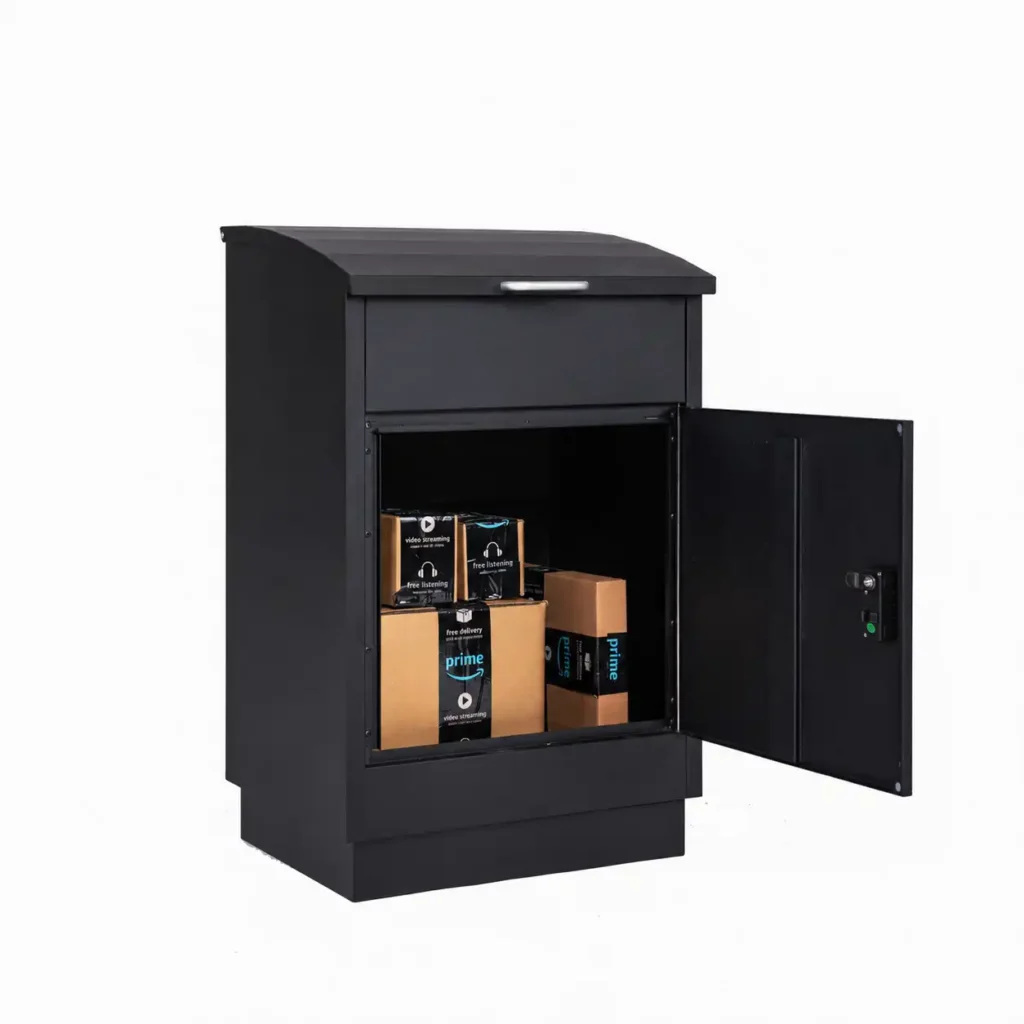
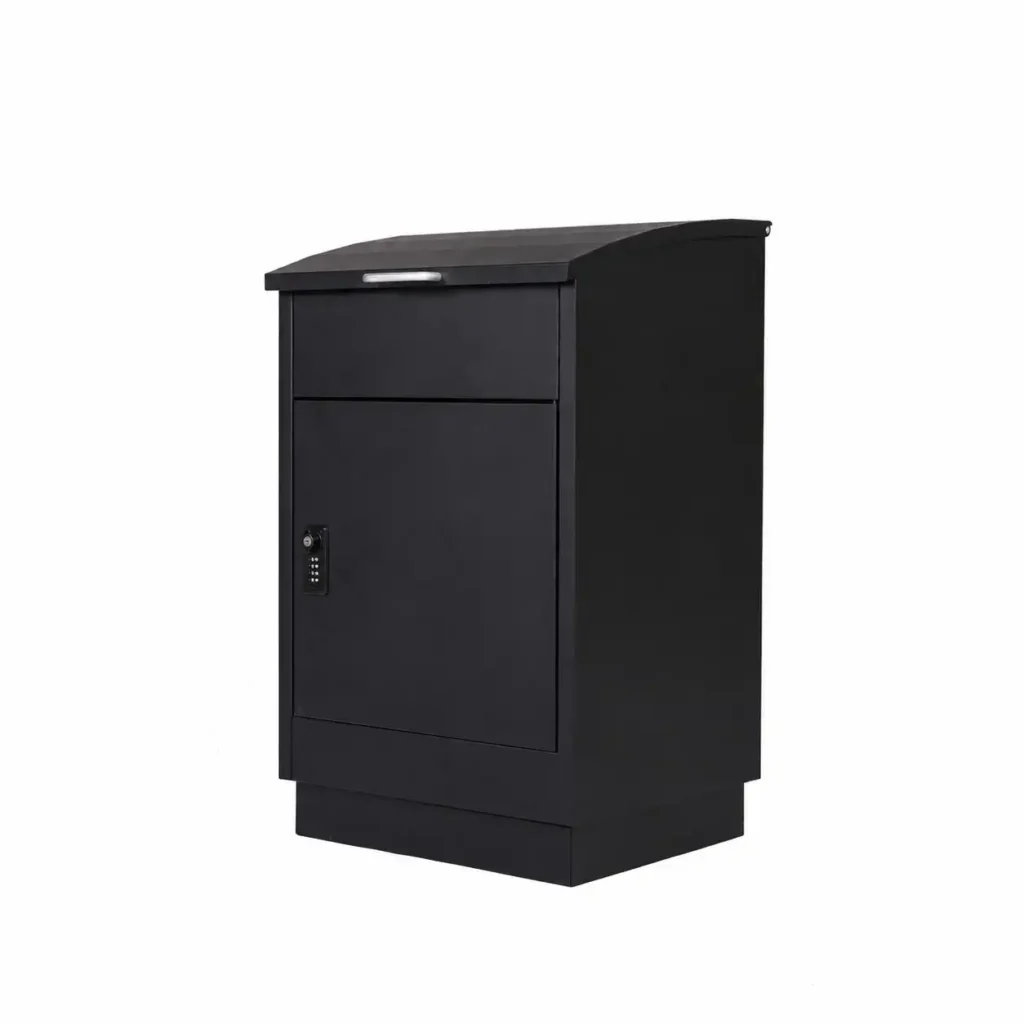
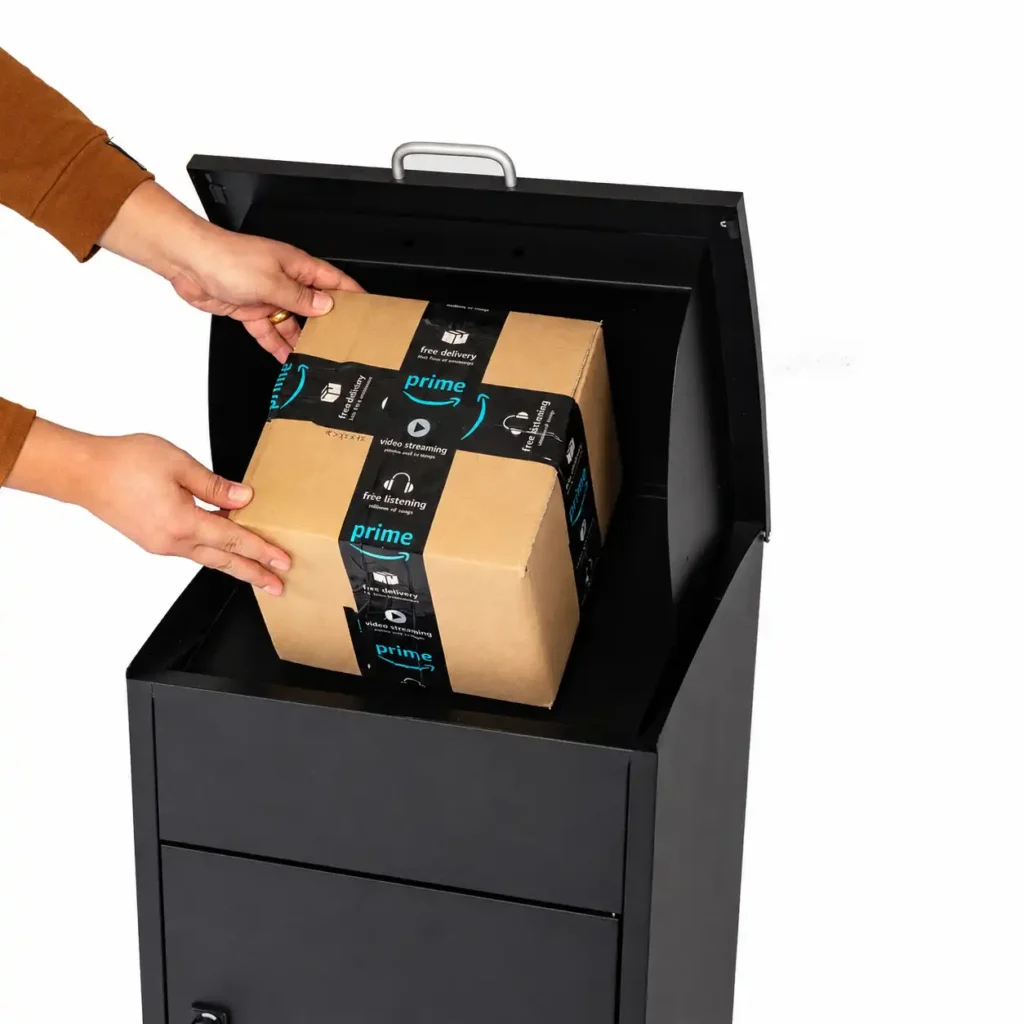
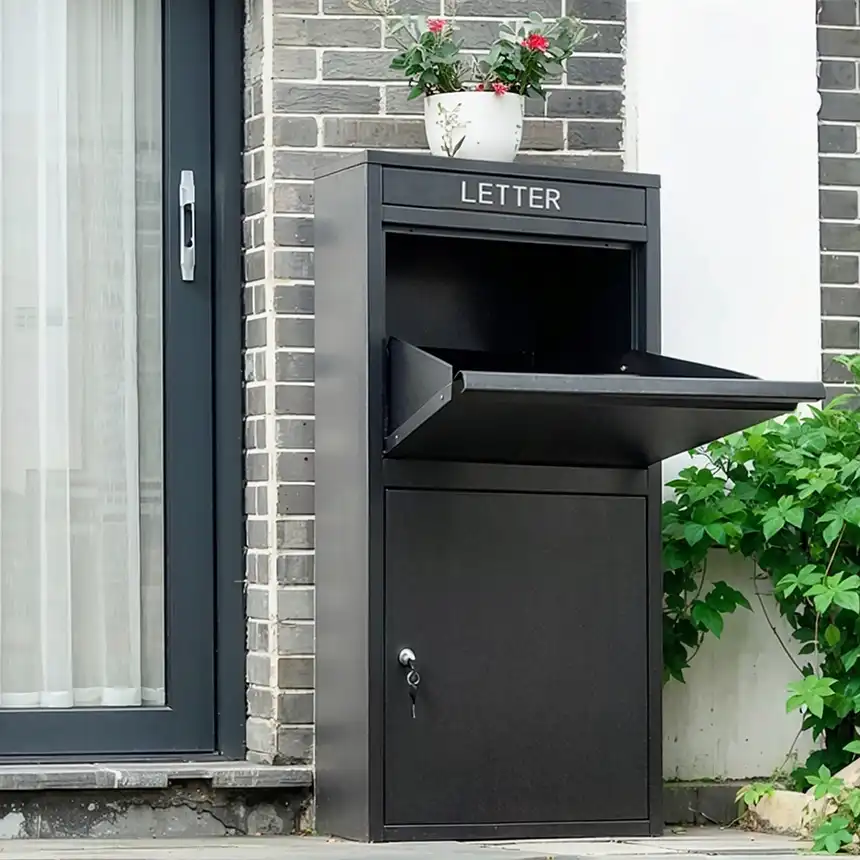
Extra Large Parcel Boxes
High-capacity parcel boxes for oversized packages and busy delivery locations.
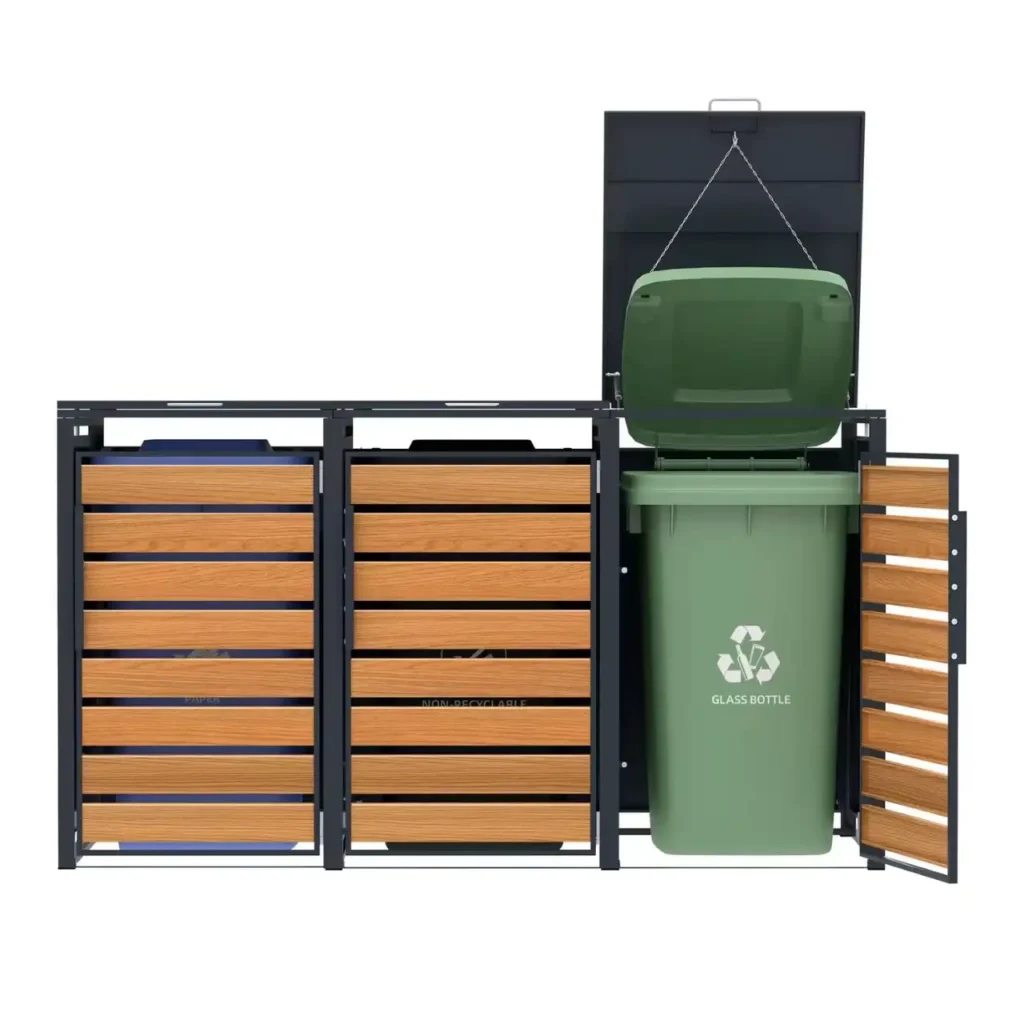
Trash Bin Enclosure
Outdoor trash bin enclosures provide a clean and secure way to store one, two, three, or multiple wheeled bins.
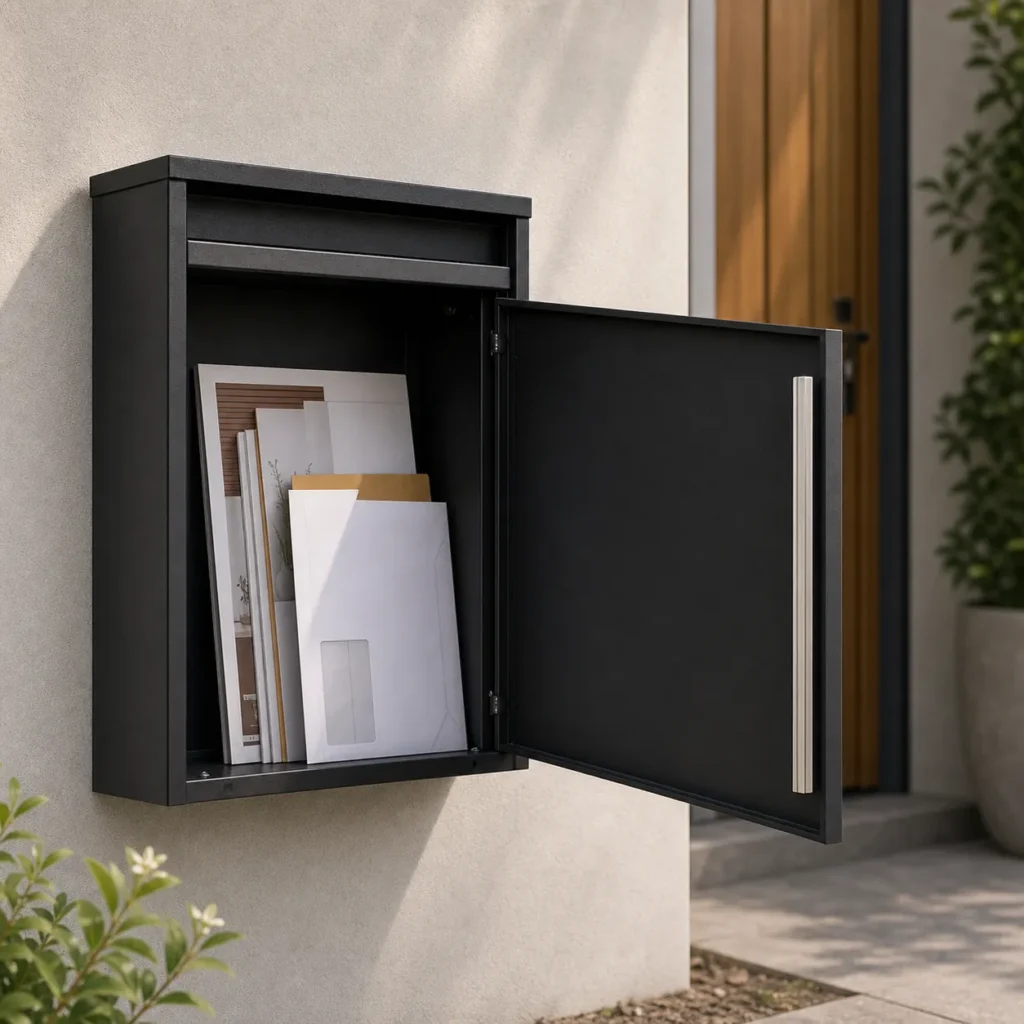
Letter and Mail Boxes
Letter boxes are designed to make mail and small parcel receiving more organized, secure, and convenient.
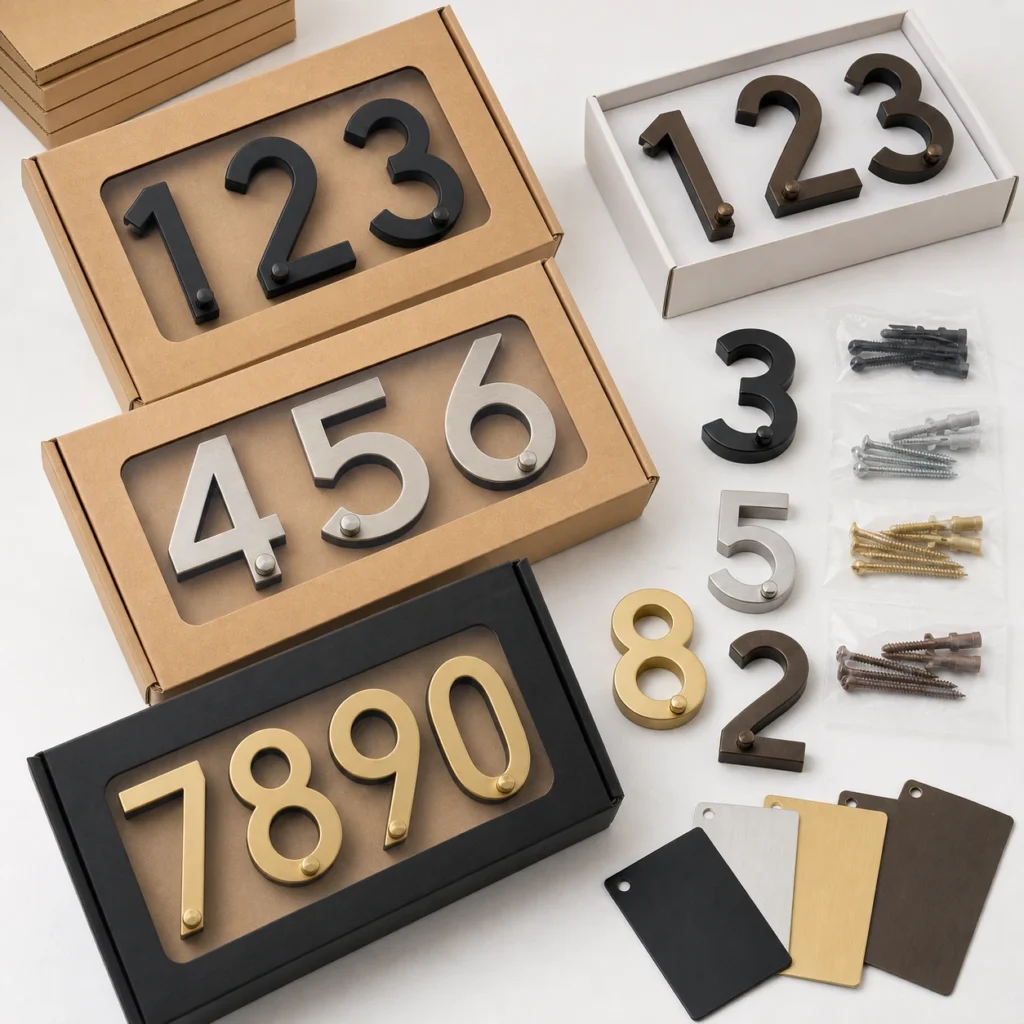
House Numbers
House numbers are small details, but they affect the first impression of a property, the visibility of an address.
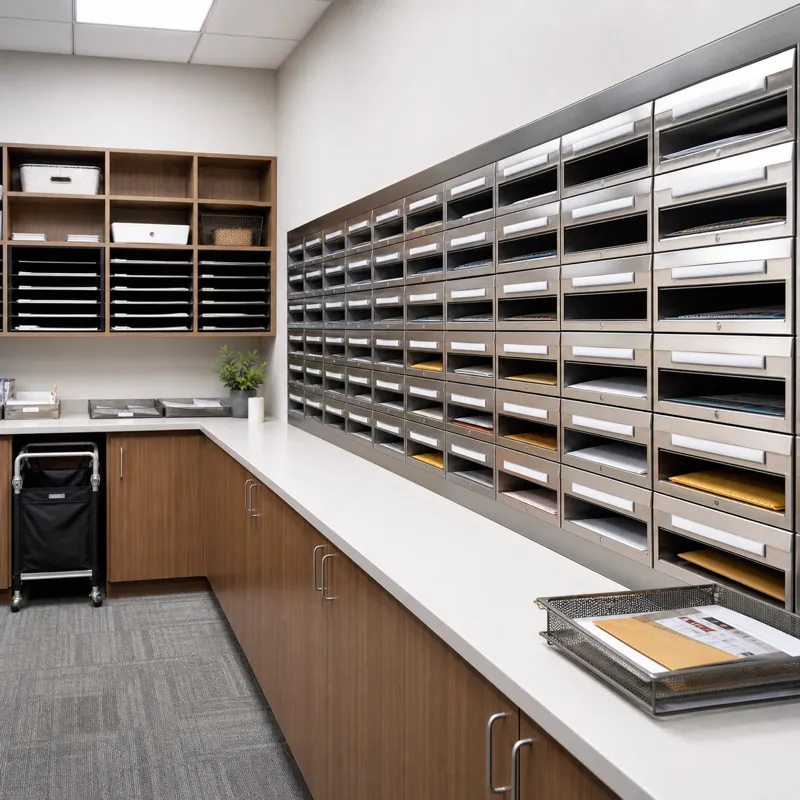
Mail Slots
Mail slots are designed for projects where appearance, size, and installation details matter.